
 |
| LESSON OVERVIEW
The main objectives of this lesson are to:
- talk about airport procedures and experiences;
- practise useful airport vocabulary;
- collaborate to develop a creative story with the target vocabulary.
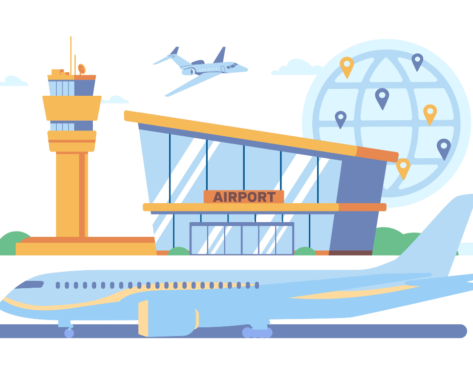
In this lesson, students explore words for airport places (e.g. departure lounge, gate, baggage reclaim) and discuss airport experiences. They identify sounds using phonetic symbols, categorise airport locations and listen to common sentences used at the airport. Students work with vocabulary for airport procedures (e.g. delayed, cancelled, boarding pass), talk about airport challenges and share their preferences regarding different airport scenarios. They also work in pairs, building creative stories using target vocabulary.
B1 / Intermediate45 min
60 minVocabulary LabPremium Plan
This is a Vocabulary Lab worksheet. With it, students are introduced to a set of vocabulary on a specific topic and practise it through controlled activities, speaking tasks and games. Learn more about it here.
WARM-UP AND VOCABULARY
This lesson focuses on airport vocabulary and starts with a warm-up. Students read riddles about things related to the airport (passenger, suitcase, passport) and guess what each one is about. They then think of more words related to the topic of the lesson. After that, students discuss questions about their travel experiences and airport preferences. Moving on, they use words for airport places (e.g. check-in desk, customs, arrivals) in pictures to complete the gaps in sentences. Then, students identify the correct pronunciation of words from the previous exercise using phonetic symbols. Afterwards, they examine a table and categorise the airport locations from the previous task based on whether they are visited before or after a flight. Next, students listen to a recording and write the place at the airport where they would hear each sentence.
MORE AIRPORT VOCABULARY AND DISCUSSION
In this part of the lesson, students read sentences about airport challenges. They practise airport vocabulary by matching words for flight procedures (e.g. board, land, take off) with their definitions. Then, students review the statements from the previous exercise and say one thing that could happen next. Following that, they complete sentence starters by writing the missing letters. Moving on, students finish the sentences (e.g. I usually start packing my carry-on…) with their own ideas and add details. Afterwards, they look at pairs of airport and travel situations (e.g. only take a carry-on OR check in a big suitcase). Students choose the option they prefer and explain why. Finally, in pairs, they choose a story title (e.g. A problem in the bag) and take turns to create a story, saying one sentence each at a time. Students include at least one target vocabulary word in each line.
HOMEWORK/REVISION
This lesson also includes an additional task that you can use as homework or revision. In the task, students complete the gaps in a story with airport vocabulary. They then read the story again and decide if the passenger’s experience was positive or negative. Give reasons. The task is available in the teacher’s version of the worksheet. You can print it and hand it out to your students. It’s also included in the e-lesson plan.
WORKSHEETS
Subscribe to unlock these and many other Standalone lesson with the Premium plan
Subscribe




A really good lesson. My student enjoyed it 🙂
My students loved it. A very complete lesson. Many thanks.
Hello.
Thank you for a great lesson.
It would be nice to have sentence frames on all these lessons in general.
You are missing the link to the audio on the PPT.
I did find a highlighted work on the teacher’s worksheet, but it does not open for me.
Thank you again.
Leslie
Hello.
Thank you for a great lesson.
It would be nice to have sentence frames on all these lessons in general.
You are missing the link to the audio on the PPT.
I did find a highlighted work on the teacher’s worksheet, but it does not open for me.
Leslie
Hi Leslie, in the e-lesson, please click on the video icon or the preview image to play the recording. Hope this helps! Please let us know if you’re still having trouble opening the recording.