
What is a Lesson Flow?
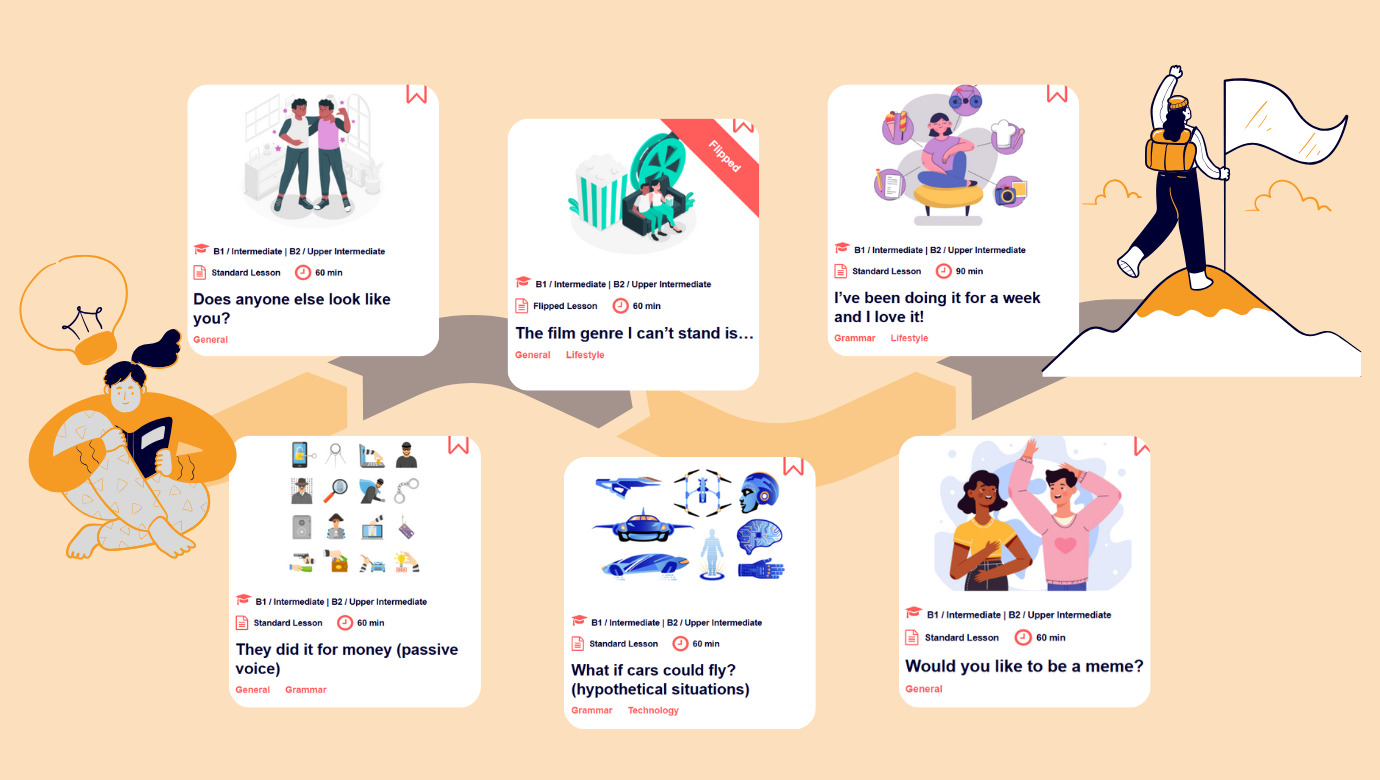
Lesson Flow is a sequence of lessons, designed to take your student on a particular learning journey. A flow contains 15-20 lessons covering the four skills as well as vocabulary, grammar and functional language. The additional follow-up lesson suggestions offer extra opportunities for reading and speaking practice, as well as targeted grammar exercises related to the topic. Lesson Flows are compilations of pre-existing ESL Brains lessons, but with a new purpose of helping teachers navigate learning in a more structured way. They serve as guidelines that you can and should customize by adding or removing lessons based on your students’ needs.
What’s inside the B1/B2 General Lesson Flow?
This flow helps students improve various aspects of their English language skills. It boosts their confidence through authentic listening materials and diverse speaking tasks. Students also develop their grammar and vocabulary, while practising new language through a range of speaking activities.
Developing language skills
With this B1/B2 General Lesson Flow, your students will work on:
- speaking skills while talking about appearance, films, art and art activism, about trying out new hobbies and activities; while debating age limits for different activities, a ban on smoking and how to avoid being a victim of a crime; when discussing emotions, guilty pleasures and what people are often grateful for; when talking about cybersecurity, digital parenting, memes, superstitions and culture shock; when role-playing different situations;
- listening skills with videos about lookalikes, sci-fi films, artists in New York, hobbies, youth activists, what a passkey is, superstitions around the world; with news reports on voting age in New Zealand, vacation guilt, crime and driverless buses; with an excerpt from a TV show; with videos in which people: thank their teachers, talk about identity theft, discuss healthy food, share how they became a meme and what culture shock is;
- reading skills when reading an article about a ban on cigarettes and one about robot chefs; when reading tweets;
- writing skills while writing stories in the past and while creating memes.
Improving grammar, vocabulary and functional language
The Flow also makes your students learn and practise:
- vocabulary: phrasal verbs for communication, cooking verbs, family collocations and phrasal verbs, phrases with ‘habit’, money phrases and idioms, words connected with travelling, phones and technology;
- grammar: phrases for expressing preferences (‘would rather’, ‘would prefer’ and ‘prefer’), the different uses of Present Continuous, Future Continuous and Future Perfect, structures with ‘used to’, verb patterns, expressing regrets (I wish…, If only…, I should have…, I regret…), other useful structures (‘have someone do something’, ‘get something done’ and ‘get someone to do something’);
- functional language: expressing opinions and preferences, saying thank you and reacting to it, giving good and bad news, phrases to express certainty and doubt.
Want to learn more?
If you’re not sure how to use our Lesson Flows or need more guidance, you can read more about them here or message us via chat or the contact form. Let us help you save some prep time and make your teaching life easier!

Comments