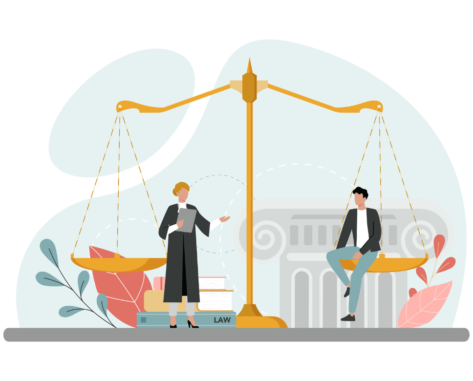

Seeking justice

Title separator

Vocabulary
Lab

crime and punishment vocabulary

LESSON OVERVIEW

The main objectives of this lesson are to:

  • talk about crimes, punishment and the justice system;
  • practise crime and punishment vocabulary;
  • tell crime stories and share perspectives.

In this lesson, students discuss crime and justice, explore words for people in court cases (e.g. suspect, defendant, witness) and read strange crime incidents. They share their opinions on punishments in different cases, work with verbs for legal actions (e.g. commit, question, accuse) and tell crime stories. Students also study word stress

B1 / Intermediate
B2 / Upper Intermediate
45 min
60 min
Vocabulary LabPremium Plan

This is a Vocabulary Lab worksheet. With it, students are introduced to a set of vocabulary on a specific topic and practise it through controlled activities, speaking tasks and games. Learn more about it here.

WARM-UP AND VOCABULARY

This lesson focuses on crime and punishment vocabulary and starts with a warm-up. Students look at pictures related to crime and tell a story about what happened. After that, they match the halves of sentences involving roles in a trial (e.g. jury, prosecution, defence). Then, students read real crime stories and complete gaps with the correct form of the words from the previous task. Following that, they say whether they agree or disagree with the punishments given in each case. Students justify their opinion. They then read sentences involving stages of a criminal case and match verbs (e.g. charge, investigate, sentence) with their definitions. Afterwards, students put the sentences in the correct order to create a story

VOCABULARY PRACTICE AND DISCUSSION

In this part of the lesson, students continue practising crime and punishment vocabulary. They say the target words from the lesson (e.g. arrest, commit, defendant) and put them into their correct word stress category (stress the first syllable and stress the second syllable). Moving on, students complete sentences about views on crime and punishment by choosing the correct verbs (e.g. people who charge/commit crimes out of poverty should…). They then finish the sentences with their own ideas and add details. Finally, students choose two or three crime-related topics (e.g. a crime you have seen in the news recently, a crime book that you’ve read) and talk about them using as many target words from the lesson as possible.

HOMEWORK/REVISION

This lesson also includes an additional task that you can use as homework or revision. In the task, students read sentences related to crimes and complete gaps with crime and punishment vocabulary. They then say what happened next, using the words from the lesson. The task is available in the teacher’s version of the worksheet. You can print it and hand it out to your students. It’s also included in the e-lesson plan.

WORKSHEETS

Comments

Title separator

Leave a Reply

Browse other materials recommended for you

Title separator
speaking lesson on big cities
B1 / Intermediate | B2 / Upper Intermediate
Speaking Class 45 min / 60 min

Problems in modern cities

Global Issues Lifestyle

Talk about urban life and its challenges in this speaking lesson on big cities! Students share their viewpoints, watch a video about the world’s largest city and discuss future city problems. They also read about urban planning projects.

vocabulary for visa applications
B1 / Intermediate | B2 / Upper Intermediate
Standard Lesson 60 min

Approved or denied? Talking about visas

Global Issues

Explore vocabulary for visa applications with this lesson! Get students discussing visa requirements, watch a video on how to get a work visa and read about recent visa laws from different countries.

ESL lesson on STEM
B2 / Upper Intermediate | C1 / Advanced
Speaking Class 45 min / 60 min

The importance of STEM

Global Issues

Let students share their ideas about science-related fields! They talk about STEM from different perspectives, watch a video about an unusual science professor and explore statistics.

discussing the news
A2 / Pre‐Intermediate | B1 / Intermediate
Standard Lesson 60 min

Have you heard about…? (discussing the news)

Global Issues

Engage your students in discussing the news with this lesson! They practise useful questions and reaction phrases, watch video segments about unusual news stories and share their opinions.

speaking lesson on posting online
B1 / Intermediate | B2 / Upper Intermediate
Speaking Class 45 min / 60 min

Think before you post

Global Issues Technology

Discuss the impact of posting videos online! Students talk about online content, privacy and consent. They watch a video segment about rules on filming in public and do a vocabulary task to practise useful phrases.

B2 / Upper Intermediate | C1 / Advanced
Critical Reading Club 45 min

Can we trust this study?

Global Issues

Discuss the reliability of research with this lesson! Students read an article debunking Blue Zones studies, practise vocabulary for talking about studies and explore ways to run research. 

vocabulary to discuss politics
B1 / Intermediate | B2 / Upper Intermediate
Vocabulary Lab 45 min / 60 min

Are you into politics?

Global Issues

In this lesson, students practise vocabulary to discuss politics, talk about their country’s political system and listen to news segments on political topics. They also play a guessing game.

ESL lesson on farming
B1 / Intermediate | B2 / Upper Intermediate
Standard Lesson 60 min

Smart farming

Global Issues Technology

Discuss modern agriculture with this ESL lesson on farming! Students share their perspectives, watch a video excerpt on farming technology and review farming vocabulary.

B2 / Upper Intermediate | C1 / Advanced
Critical Reading Club 45 min

Image-based reality

Global Issues Technology

Talk about the power of online images! With this lesson, students read an article about how online images shape the way we think and revise vocabulary. They also talk about bias in online images and AI-generated content.

Show more lessons

Questions

Title separator

Is there a minimum subscription period if I choose a monthly subscription?

No, there's no minimum required number of subscription months. You can cancel any time you want. Basically, you can sign up and then cancel your subscription the next day, which will mean you have access for 1 month and won't be charged again.

What currencies can I pay in for my subscription?

Our default currency is USD (American dollar), but you can also pay in EUR (euro), GBP (British pound sterling) or PLN (Polish zloty). You can change the currency you want to pay in at the Pricing page before selecting a subscription plan.

How can I edit an e-lesson plan?

You can get your own editable copy of an e-lesson plan and make changes to it. To do so, either (1) make a copy of it on your Google Drive (preferable method) or (2) download it in a Powerpoint format (but formatting might be a bit off so we can’t guarantee that it will work well).
Read more FAQ
Title separator

ESL Brains

Forgot password?
or continue with
Title separator
Title separator