What a chore!

Title separator

Speaking
Class

talk about chores

LESSON OVERVIEW

The main objectives of this speaking lesson are to:

  • do various activities to talk about chores;
  • practise chore-related vocabulary; 
  • watch a funny video on doing chores at work.

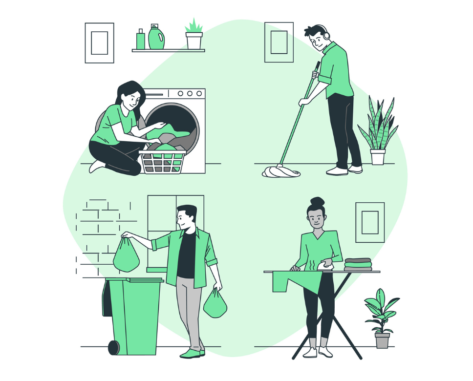
In this speaking lesson, students talk about chores, work with vocabulary (e.g. do the dishes, make the bed, mop the floor, etc.) and watch a short funny video where a group of people use a chore wheel. Students discuss the frequency of chores, tips to make them fun and their personal experiences. Students also do role-play tasks in which they assign and prioritise chores in different scenarios.

A2 / Pre‐Intermediate
B1 / Intermediate
45 min
60 min
Speaking ClassUnlimited Plan

This is a Speaking Class worksheet. It includes a variety of tasks that let your students practise their speaking skills. This lesson format does not focus on grammar or vocabulary. Learn more about it here.

WARM-UP AND VOCABULARY

This lesson begins with a warm-up in which students look at photos related to chores, say what words they think of when they see them and explain why the photos make them think of these words. After that, they create chores using verbs and nouns from boxes (e.g. vacuum the carpet). Students describe a chore to their partner using no more than three words. Their partner should guess what chore they mean. Following that, students think of chores for different categories (e.g. chores people do in the kitchen, chores people do outside, chores you hate, etc.). Next, they talk about chores and discuss questions about reasons people like or dislike chores, the frequency of chores, and ways to make chores more enjoyable. 

VIDEO AND DISCUSSION

At this point in the lesson, students prepare to watch a video in which a group of people use a chore wheel at work. Students say what they think the chore wheel is for and watch the video to check their ideas. Following that, they read sentences about opinions on the chore wheel and chores at the workplace. In the task, students choose one option to complete each of the sentences and give some details (e.g. I have/haven’t tried a similar idea to decide who does what). Next, they talk about chores by looking at some ways of dealing with chores (e.g. chore day – doing all chores on a particular day once a week) and discussing who such ideas are good for. Finally, they do role-play tasks where they assign and prioritise chores in different scenarios.  

WORKSHEETS


Comments

Title separator

Leave a Reply

  1. henriqueadr

    Great lesson! Exercise on page 5 was very confusing for the students though…

    1. Ewa

      Hi, thanks! If you’re referring to the task in slide 5, it’s a guessing game, kind of like Taboo but simpler. A students picks a chore and says three words to describe it, and their partner needs to guess the chore. There is an example in the slide, and another one would be: student A says ‘plate’, ‘clean’ and ‘machine’ and student B (hopefully) guesses ‘load the dishwasher’. Hope this helps!

  2. silvigir

    Great lesson Ewa, thanks!

    1. Ewa

      Thank you, glad to hear that 🙂

Browse other materials recommended for you

Title separator
ESL lesson on body parts
A2 / Pre‐Intermediate | B1 / Intermediate
Vocabulary Lab 45 min / 60 min

Guess the body part

General

Discuss how we use parts of the body with this ESL lesson! Students listen to conversations about accidents and pain, work in pairs and play a guessing game.

speaking lesson on fears
B1 / Intermediate
Speaking Class 45 min / 60 min

What are you afraid of?

General

This speaking lesson on fears lets students talk about what they’re scared of. They discuss ways of overcoming common fears and watch a video about fear of the dark. Students can review useful vocabulary with an extra task.

describing people in photos
A1 / Elementary | A2 / Pre‐Intermediate
Standard Lesson 60 min

They’re wearing… (talking about people in photos)

General

Practise ‘wear’, ‘carry’ and ‘hold’ while describing people in photos with this lesson! Students revise clothing vocabulary and watch an ad. They also work in pairs and play a fun game.

ESL lesson on Past Simple
A2 / Pre‐Intermediate
Standard Lesson 60 min

A message in a bottle (Past Simple)

General Grammar

Talk about messages in bottles with this ESL lesson on Past Simple! Students analyse and practise Past Simple forms, watch a video about a message-in-a-bottle discovery and write their own message in a bottle.

vocabulary for places in town
A2 / Pre‐Intermediate
Vocabulary Lab 45 min / 60 min

All around town

General

Practise vocabulary for places in town with this lesson! Students talk about where they live, give opinions and share experiences. They explore the names of places and work on pronunciation. 

ESL lesson on be going to
A1 / Elementary | A2 / Pre‐Intermediate
Standard Lesson 60 min

Let’s have a party! (going to)

General Grammar

Students discuss parties in this ESL lesson on be going to. They practise be going to to talk about the future, practise phrases for preparing the house for guests and imagine planning a party.

talking about transport
A2 / Pre‐Intermediate | B1 / Intermediate
Speaking Class 45 min / 60 min

Transport today and tomorrow

General Lifestyle

Get students talking about transport with this lesson! They review transport vocabulary, watch two short videos about new transport options and discuss the advantages and disadvantages of transport choices.

music vocabulary
B1 / Intermediate | B2 / Upper Intermediate
Vocabulary Lab 45 min / 60 min

Feel the music

General

Practise music vocabulary with this lesson! Students discuss their music preferences, share their experiences and look at modern music habits. They also practise asking and answering music-related questions.

lesson on optimism and pessimism
B1 / Intermediate
Speaking Class 45 min / 60 min

When life gives you lemons

General

Let students explore how to keep a positive mindset with this lesson! They talk about optimistic and pessimistic viewpoints and watch part of a video about a person handling a situation creatively.

Show more lessons

Questions

Title separator

Is there a minimum subscription period if I choose a monthly subscription?

No, there's no minimum required number of subscription months. You can cancel any time you want. Basically, you can sign up and then cancel your subscription the next day, which will mean you have access for 1 month and won't be charged again.

What currencies can I pay in for my subscription?

Our default currency is USD (American dollar), but you can also pay in EUR (euro), GBP (British pound sterling) or PLN (Polish zloty). You can change the currency you want to pay in at the Pricing page before selecting a subscription plan.

How can I edit an e-lesson plan?

You can get your own editable copy of an e-lesson plan and make changes to it. To do so, either (1) make a copy of it on your Google Drive (preferable method) or (2) download it in a Powerpoint format (but formatting might be a bit off so we can’t guarantee that it will work well).
Read more FAQ
Title separator

ESL Brains

Forgot password?
or continue with
Title separator
Title separator