
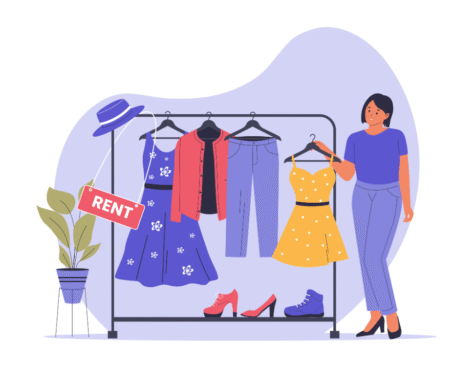
 |
| LESSON OVERVIEW
The main objectives of this lesson are to:
- discuss renting items;
- watch a video about the trend of renting clothes;
- practise useful vocabulary for talking about used things.
With this lesson, students exchange experiences borrowing and renting things, discuss clothing rental after the Covid-19 pandemic and watch a video on renting clothes. They share their thoughts on wardrobe rental, review compound adjectives to talk about rental services (e.g. on-demand, long-standing, high-margin) and debate the social impacts of the renting economy. Students reflect on situations where they would buy or rent things, read reviews of people who rented objects and explore vocabulary for signs of use (e.g. warp, sag, rust away). They also chat about the risks of renting items and factors in the rental economy.
WARM-UP AND VIDEO
This lesson starts with a warm-up. Students look at varied things (e.g. sports equipment, home appliances) and say which of them they have borrowed or rented. They give details. Afterwards, students discuss questions about their opinion on clothing rental post-pandemic. Moving on, they watch a video about renting clothes and make notes on what it says about the questions from the previous task. Then, students say if they agree with different opinions on clothing rental (e.g. the future of fashion is renting, not buying). After that, they complete compound adjectives (e.g. sought-after, Instagram-worthy, hassle-free) in opinions on renting instead of owning. Students then choose three opinions to elaborate on. Following that, they complete questions about the social impacts of the renting economy. Students use the compound adjectives from the previous exercise. Next, they discuss the questions.
TALKING ABOUT USED THINGS
In this part of the lesson, students engage in talking about used things and think of particular items they might need in different situations (e.g. you’re setting up a home office). They decide which they would buy and which they would rent. Students give details. Afterwards, they read reviews of people who decided to rent some items and decide what the items might be. Students then explain words and phrases for signs of use (e.g. chip, fray, have dents). Moving on, they say what might go wrong with renting various items (e.g. guitar, tuxedo, plumber’s toolkit) using the vocabulary for talking about used things. Next, students put them in order from safest to riskiest to rent. Following that, they choose a point related to trends and factors in the rental economy and talk about it for two minutes.
HOMEWORK/REVISION
This lesson also includes an additional task that you can use as homework or revision. In the task, students correct the mistakes in compound adjectives in sentences. They then finish the sentences with their own ideas, using the target words and phrases for signs of use. The task is available in the teacher’s version of the worksheet. You can print it and hand it out to your students. It’s also included in the e-lesson plan.
WORKSHEETS
Subscribe to unlock these and many other Standalone lesson lesson plans with the Unlimited plan
Subscribe









Great lesson but a quick question about page 20. Is there an error in the sentence – Does designing everything to be hassle free risk erode our ability to be patient? I think it should be Eroding. Thank you
We’re thrilled to hear that you like the lesson 🙂 Re the question, you’re right. Thanks for letting us know, we’ve just fixed that 🙂
What is meant by “Clothing rental services make fashion more democratic”? Strange way to use the word democratic.
Thank you for your comment! You’re right that ‘democratic’ might sound unusual here, but it’s because it isn’t being used in the political sense. In this sentence, we used it in the meaning ‘more accessible to a wider range of people’, especially people who may not be able to afford designer clothes.