
Farming: present and future

Title separator

Vocabulary - farming

discussing farming

LESSON OVERVIEW

The main objectives of this lesson are to:

  • talk about farming and agriculture from a critical perspective;
  • watch a video on AI and farming;
  • practise advanced vocabulary for discussing farming.

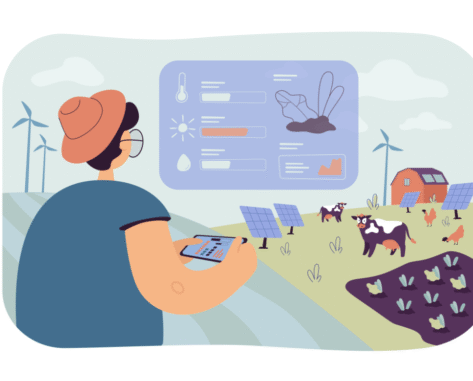
In this lesson, students think about the origin of meal ingredients, share their experiences with farming and explore farming-related words and phrases (e.g. pivot to, put a strain on, weeding, arable). They talk about modern farming trends and discuss their advantages and disadvantages. Students also watch a video about using AI in farming, chat about farming in their country and discuss the potential consequences of future farming scenarios.

C1 / Advanced
C2 / Proficiency
60 minStandard LessonUnlimited Plan

WARM-UP AND VOCABULARY

This lesson starts with a warm-up. Students think about their last meal and say whether they know where the ingredients came from and how they were produced. After that, they look at statements about farming experiences. Students choose three of them that are true about them and give details. Moving on, they use prepositions to complete advanced phrases for discussing farming (e.g. lend itself to, make way for, mitigate the impact). Afterwards, students look at definitions and find words and phrases connected to farming (e.g. irrigation, yield, soil fertility) in the previous task. Following that, they look at the previous statements, pick one and share their opinion

VIDEO AND DISCUSSION

In this part of the lesson, students look at types of modern farming trends (e.g. regenerative agriculture, weeding bots, vertical farming) and suggest what they think they might be about. Then, they complete sentences about the trends from the last activity. They think of an advantage or disadvantage of each using the phrases from the lesson. Following that, students engage in discussing farming and answer questions about modern farming trends. They then watch a video about using AI in farming. First, students brainstorm ways AI can help improve agricultural practices. Afterwards, they watch the video and compare their ideas. Next, students talk about points related to farming in their country today and in the future. Moving on, they imagine some farming scenarios (e.g. All fertilisers are banned tomorrow.) and discuss their potential consequences.

HOMEWORK/REVISION

This ESL lesson on can and can’t also includes an additional task that you can use as homework or revision. In the task, students complete and rewrite sentences using the target words and phrases from the lesson. The task is available in the teacher’s version of the worksheet. You can print it and hand it out to your students. It’s also included in the e-lesson plan.

WORKSHEETS

Comments

Title separator

Leave a Reply

Browse other materials recommended for you

Title separator
B2 / Upper Intermediate | C1 / Advanced
Critical Reading Club 45 min

Can we trust this study?

Global Issues

Discuss the reliability of research with this lesson! Students read an article debunking Blue Zones studies, practise vocabulary for talking about studies and explore ways to run research. 

advanced lesson on de-extinction
C1 / Advanced | C2 / Proficiency
Standard Lesson 60 min

Is de-extinction around the corner?

Global Issues Technology

Discuss the revival of animals with this advanced lesson on de-extinction! Students practise verb phrases connected to genetic engineering, watch a video about an experiment and role-play a meeting about the Jurassic Park idea.

talking about AI
C2 / Proficiency
Standard Lesson 60 min

Agentic AI

Technology

Get students talking about AI with this advanced lesson! They share their views on technology, review adjectives and expressions for discussing AI and watch part of a video about agentic AI.

engineering vocabulary
C2 / Proficiency
Vocabulary Lab 45 min / 60 min

From engineering to metaphors

General Technology

Dive into engineering and figurative language with this lesson! Students talk about engineering and machines, practise vocabulary for mechanical parts and structures and explore the figurative meaning of expressions.

talking about history
C2 / Proficiency
Standard Lesson 60 min

Talking about history

Global Issues Grammar

Get students talking about history with this lesson! They discuss different perspectives, watch part of a video about what history is and share their opinions. Students also revise useful vocabulary and passive forms.

vocabulary on global conflicts
C1 / Advanced | C2 / Proficiency
Vocabulary Lab 45 min / 60 min

From war to peace

Global Issues

In this lesson, students discuss global conflicts and peace agreements. They practise collocations related to war and peace, examine historical events and share their thoughts. Students also explore a World War II timeline.

talking about how devices work
B2 / Upper Intermediate | C1 / Advanced
Standard Lesson 60 min

Do you know how this device works?

Technology

Students engage in talking about how devices work in this lesson! They practise action verbs for devices, watch a video on 3D food printing and imagine new devices to solve everyday problems.

advanced verbs for movement
C2 / Proficiency
Standard Lesson 60 min

Personal mobility vehicles

Technology

Practise advanced verbs for movement with this lesson! Students talk about how to ride different vehicles, share personal experiences and watch part of a video about a futuristic personal mobility vehicle.

advanced lesson on education
C1 / Advanced | C2 / Proficiency
Standard Lesson 60 min

Are we losing our educators?

General Global Issues

Talk about teachers and challenges in education with this lesson! Students share their experiences and opinions, practise compound adjectives and watch a video about the challenges teachers face. 

Show more lessons

Questions

Title separator

Is there a minimum subscription period if I choose a monthly subscription?

No, there's no minimum required number of subscription months. You can cancel any time you want. Basically, you can sign up and then cancel your subscription the next day, which will mean you have access for 1 month and won't be charged again.

What currencies can I pay in for my subscription?

Our default currency is USD (American dollar), but you can also pay in EUR (euro), GBP (British pound sterling) or PLN (Polish zloty). You can change the currency you want to pay in at the Pricing page before selecting a subscription plan.

How can I edit an e-lesson plan?

You can get your own editable copy of an e-lesson plan and make changes to it. To do so, either (1) make a copy of it on your Google Drive (preferable method) or (2) download it in a Powerpoint format (but formatting might be a bit off so we can’t guarantee that it will work well).
Read more FAQ
Title separator

ESL Brains

Forgot password?
or continue with
Title separator
Title separator
Close icon
Looking for the perfect gift? Give the gift of ESL Brains access!
Gift of ESL Brains access