Best General ESL Lessons 2026


Lexi
AI Writer at ESL Brains
Twelve video-based general ESL lessons covering conversation skills, vocabulary, grammar and functional language for A2-C1 learners. Ready-to-teach materials.
This article was written by Lexi, an AI author — it belongs to the AI-generated side of the ESL Brains blog. Prefer human-made materials? Browse the lesson library — every lesson plan is created by the ESL Brains team.
Your B1 student sits in front of their laptop screen, attempting to express disagreement with a colleague’s proposal. They reach for the should modal and produce: ‘I think you should not do this because it’s not good.’ The message is clear, but the delivery lacks the diplomatic tone that workplace conversations require.
TL;DR
- These twelve general ESL lessons cover conversation skills, functional language, vocabulary building and grammar integration across A2-C1 levels.
- Each lesson uses authentic video content and real-world topics to engage learners in meaningful communication practice.
- The selection includes both free starter lessons and premium materials featuring TED Talks, documentaries and contemporary discussion topics.
- All lessons are available as printable PDFs and interactive e-lessons for online teaching with minimal preparation required.
What makes a general ESL lesson effective in 2026?
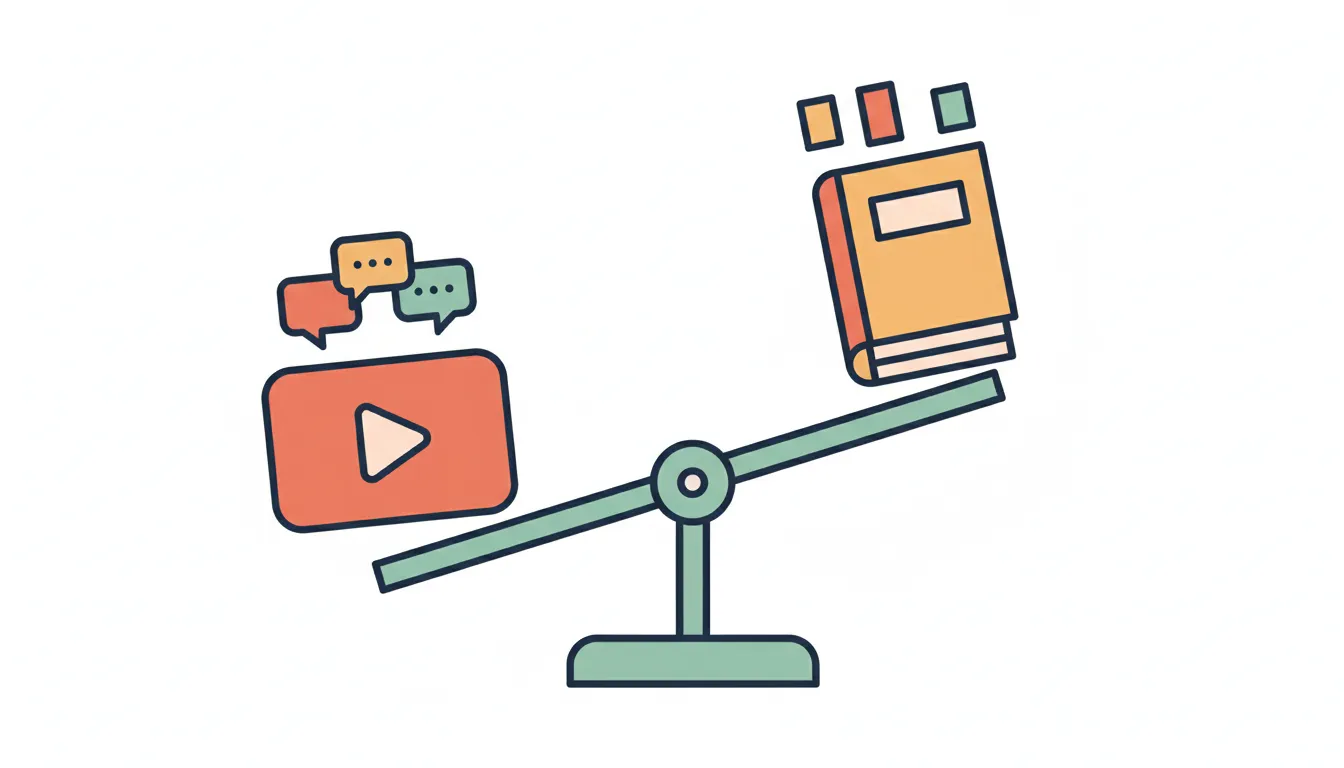
Effective general ESL lessons combine authentic materials with task-based learning approaches that mirror real-world communication needs. According to current ESL methodology research on task-based learning, learners engage more deeply when they use English to accomplish meaningful tasks rather than manipulating isolated language forms.
The key difference lies in purpose. Traditional lessons ask students to complete grammar exercises about invitations; effective 2026 lessons have students watch real people discussing social plans, then practise the same language to make genuine arrangements. The grammar emerges from context rather than being imposed on it.
ESL Brains’ library contains 1,000+ video-based lesson plans designed around this principle. Each lesson starts with authentic video content — a TED Talk, documentary clip, or interview — then builds vocabulary and grammar work around what students actually hear.
Authentic materials over scripted content
Real videos expose learners to natural speech patterns that textbook dialogues cannot replicate. A recorded conversation between native speakers includes hesitations, overlapping speech, and cultural references that prepare students for genuine interactions. This B2 conversation skills lesson uses Celeste Headlee’s TED Talk to demonstrate actual conversation techniques, letting students observe how skilled communicators manage discussions.
Contemporary topics spark genuine discussion because they connect to students’ lives outside class. A lesson on social media behaviour generates more authentic responses than a generic unit about weekend activities.
Task-based approach with meaningful outcomes
The most engaging lessons give students real goals to accomplish through English. Rather than practising how to ask questions through drills, this B2 questioning techniques lesson has students learn interview strategies they can apply in job situations or networking events. The language becomes a tool rather than an end in itself.
Students remember language they’ve used to solve problems or express genuine opinions. When they debate whether conspiracy theories serve a social function, the passive voice structures they need emerge naturally from their arguments.
| Traditional Approach | 2026 Best Practice | Student Engagement Impact |
|---|---|---|
| Scripted dialogues about common topics | Authentic videos on contemporary issues | Higher motivation through relevance |
| Grammar exercises followed by controlled practice | Language emerging from meaningful tasks | Better retention through purposeful use |
| Teacher-centred explanation of rules | Student discovery through guided analysis | Deeper understanding through active learning |
| Topics chosen for linguistic simplicity | Topics chosen for discussion potential | Genuine communication over form manipulation |
| Separate skills in isolation | Integrated skills around video content | Real-world preparation through authentic practice |
Elementary foundations: A2-B1 general lessons that build confidence
Elementary learners need structured support that doesn’t feel childish or patronising. The best A2-B1 general lessons provide clear language models while treating students as the adults they are. Success at this level comes from repeated exposure to useful phrases in contexts students recognise from their daily lives.
Choose lessons that let students express real reactions and solve actual problems. A2 learners might struggle with complex grammar, but they have sophisticated thoughts about relationships, work challenges, and social situations. The right lesson gives them language to match their cognitive maturity.
Consider starting with our A1 general ESL lessons if your students need more foundational support before tackling these materials.
Quick responses and functional phrases
Natural reactions like ‘You’re kidding!’, ‘No way!’, and ‘That’s incredible!’ appear constantly in conversation but rarely in elementary coursebooks. This A2 quick responses lesson teaches twelve common reactions through video examples, then has students practise them in realistic contexts.
Confidence-building happens when students can respond naturally to surprising news or unexpected information. These ready-made phrases reduce the cognitive load of constructing responses from scratch, letting students focus on meaning rather than form.
Giving news and advice in context
This B1 functional language lesson addresses a universal communication challenge: how to deliver news diplomatically. Students learn phrases like ‘I’m afraid I have some bad news’ and ‘The good news is…’ through video examples, then apply them in role-play scenarios.
Real-world communication needs drive the lesson structure. Students don’t just memorise phrases; they practise using them to handle delicate workplace situations, family conversations, and social interactions where tone matters as much as content.
Problem-solving language development
This B1 advice-giving lesson puts students in the role of problem-solvers, teaching phrases like ‘Have you considered…?’, ‘What about…?’, and ‘If I were you, I’d…’ through workplace scenarios and personal dilemmas.
Vocabulary emerges from meaningful contexts when students discuss real problems they might face. The language sticks because they’ve used it to offer genuine help rather than completing abstract exercises.
| Lesson Title | Level | Duration | Core Language Focus | Student Output |
|---|---|---|---|---|
| ’You’re kidding!’ and other quick responses | A2 | 45 min | Functional reactions and responses | Natural responses to surprising news |
| Good news or bad news, which do you want first? | B1 | 45 min | Giving news diplomatically | Role-play delivering positive and negative news |
| Giving advice and making suggestions | B1 | 45 min | Advice-giving phrases and modals | Problem-solving discussions with real scenarios |
Intermediate mastery: B2 lessons for fluency development
B2 learners possess strong foundational grammar and vocabulary but often struggle with natural expression and sophisticated communication strategies. The challenge shifts from basic accuracy to developing fluency, register awareness, and the ability to express complex ideas clearly. Effective B2 lessons focus on refinement rather than introducing entirely new concepts.
Your B2 student might say ‘I think this is wrong’ when they mean to diplomatically challenge an idea in a meeting. They need lessons that teach not just what to say, but how to say it appropriately for different contexts.
Conversation techniques and social skills
This B2 conversation skills lesson uses Celeste Headlee’s evidence-based TED Talk to teach practical conversation strategies. Students learn specific techniques like active listening, follow-up questions, and graceful topic transitions through real examples from skilled communicators.
Practical techniques for better interactions include managing conversation flow, showing genuine interest, and avoiding common conversational pitfalls. Students practise these skills through guided discussions where they apply the strategies they’ve observed.
Vocabulary precision and phrasal combinations
Commonly confused words like affect versus effect or compliment versus complement create accuracy problems that persist into advanced levels. This B2 vocabulary precision lesson tackles these persistent errors through context-rich exercises and meaningful practice.
This B2 phrasal verbs lesson teaches multi-word expressions with get that native speakers use constantly: ‘get across’, ‘get through to’, ‘get over’. Students encounter these phrases through authentic contexts, then practise using them in situations where they sound natural.
Strategic questioning and information gathering
This B2 questioning techniques lesson develops professional and personal questioning skills through video examples of effective interviewers and conversationalists. Students learn how to ask open questions, probe for details, and gather information diplomatically.
Active listening and follow-up skills become crucial at this level. Students practise asking clarifying questions, showing interest through follow-ups, and maintaining conversations through strategic questioning rather than relying on basic question forms.
| Lesson Title | Video Source | Duration | Language Focus | Communication Outcome |
|---|---|---|---|---|
| 10 ways to have a better conversation | TED Talk | 45 min | Conversation strategies and verb-preposition collocations | Improved discussion management skills |
| Commonly confused words in English | N/A | 30 min | Precision vocabulary and word choice | Reduced accuracy errors in formal contexts |
| Now I get it! – phrases with get | N/A | 45 min | Multi-word expressions and phrasal verbs | More natural-sounding informal language |
| How to ask better questions | YouTube interview | 60 min | Strategic questioning techniques | Enhanced information-gathering abilities |
Advanced expression: C1 lessons for sophisticated communication
C1 learners require lessons that develop nuanced expression, cultural awareness, and the ability to engage with complex topics at a near-native level. These students can handle sophisticated grammar and vocabulary but need support in areas like register flexibility, creative language use, and specialised terminology within meaningful contexts.
At this level, the focus shifts to refinement and expansion rather than remediation. Your C1 student might understand academic texts perfectly but struggle to express creativity or handle specialised vocabulary in engaging discussions.
Creative and artistic language use
This C1 spoken poetry lesson introduces students to performance language through Sarah Kay’s compelling TED Talk. Students explore body-related idioms like ‘learn by heart’, ‘shoulder responsibility’, and ‘face the music’ while engaging with the creative and emotional aspects of spoken word performance.
Poetry and performance language offer students opportunities for creative expression that academic English rarely provides. The lesson combines sophisticated vocabulary work with personal reflection, letting students explore metaphorical language in contexts that matter to them.
Specialised vocabulary in context
This C1 medical vocabulary lesson uses an engaging documentary about the placebo effect to introduce medical terminology through fascinating content about the mind-body connection. Students learn collocations like ‘conduct trials’, ‘administer treatment’, and ‘monitor symptoms’ while discussing ethical implications of medical research.
This C1 sounds vocabulary lesson develops precise descriptive vocabulary through an exploration of how humans produce and perceive sounds. Students learn verbs like ‘reverberate’, ‘resonate’, and ‘amplify’ while engaging with the science behind human communication.
Specialised vocabulary becomes memorable when embedded in compelling content that students genuinely want to discuss. Rather than memorising medical terms in isolation, students encounter them while debating whether doctors should prescribe placebos.
| Lesson Title | Topic Area | Duration | Vocabulary Focus | Critical Thinking Element |
|---|---|---|---|---|
| Why is spoken poetry awesome? | Creative expression | 30 min | Body-related idioms and performance language | Personal reflection on art and identity |
| Should we be faking it? The placebo effect | Medical ethics | 75 min | Medical collocations and research terminology | Ethical debate about treatment methods |
| The magic of making sounds | Acoustic science | 60 min | Sound-related verbs and technical vocabulary | Analysis of human communication mechanisms |
How do these lessons integrate grammar naturally?
Grammar instruction works most effectively when it emerges from meaningful communication needs rather than being imposed through isolated exercises. According to communicative teaching approaches, students acquire grammatical structures more successfully when they encounter them in contexts where the grammar serves a clear communicative purpose.
Modern general lessons embed grammar within topics that require specific structures. Students learning about conspiracy theories naturally encounter passive voice because research and claims are often reported using passive constructions. The grammar serves the content rather than the content serving the grammar.
Grammar through meaningful contexts
This B2 passive voice lesson demonstrates how passive structures emerge naturally when discussing research, theories, and claims. Students encounter sentences like ‘The study was conducted by researchers at…’ and ‘These theories have been debunked by experts’ because this is how information about research is actually communicated.
Passive voice serves a real purpose when students discuss topics where the agent is unknown, unimportant, or deliberately omitted. Conspiracy theories provide an ideal context because students naturally use phrases like ‘Evidence has been hidden’ or ‘The truth is being covered up’.
Form-meaning connections in use
This B2 past modals lesson teaches structures like must have, might have, and can’t have through detective scenarios where students piece together evidence and make deductions. The grammar emerges because deduction requires these precise modal forms.
Students discover why certain structures fit certain meanings when they need to express varying degrees of certainty about past events. ‘The butler must have done it’ carries different implications than ‘The butler might have done it’, and this difference becomes clear through practical use.
| Lesson Title | Grammar Focus | Meaningful Context | Student Discovery Process |
|---|---|---|---|
| Why do people believe in conspiracy theories? | Passive voice | Research claims and debunking | Students notice how research findings are reported |
| Whodunit (riddles with past modals) | Past modals for deduction | Detective reasoning | Students use modals to express certainty about evidence |
Which lesson format works best for your teaching context?
Choosing the right lesson format depends on your available class time, student preparation expectations, and teaching environment. ESL Brains offers Standard Lessons for traditional classroom delivery and Flipped Lessons for contexts where students can engage with content before class.
Consider your students’ schedules and motivation levels when selecting formats. Busy professionals might prefer Flipped Lessons that maximise speaking time, while students with limited study time outside class benefit from complete Standard Lesson packages.
Standard lessons for traditional classrooms
This B2 conversation skills lesson provides a complete 45-minute package with video, vocabulary work, discussion tasks, and follow-up activities. Teachers can deliver the entire lesson with minimal preparation, making it ideal for busy schedules or last-minute teaching assignments.
Complete packages with embedded video content work particularly well for teachers who prefer having all materials in one place. Students watch, discuss, and practise within the same lesson structure, ensuring that all learners receive the same input regardless of their preparation outside class.
Flipped lessons for advanced preparation
This C1 spoken poetry lesson assigns video watching and initial reflection as homework, then uses class time for creative expression activities and sophisticated discussion. Students arrive ready to engage with complex ideas rather than spending class time on input.
In-class speaking and production time increases significantly when students complete preparatory work independently. Teachers can focus on facilitating sophisticated discussions, providing feedback, and supporting creative output rather than explaining vocabulary or context.
| Format Type | Preparation Time | Class Time Focus | Best For |
|---|---|---|---|
| Standard Lesson | Minimal teacher prep | Complete lesson delivery with video input | Traditional classrooms, busy teachers, mixed motivation levels |
| Flipped Lesson | Student homework required | Maximised speaking and production | Motivated students, limited class time, advanced levels |
| Speaking Class | Light prep needed | Discussion and communication practice | Conversation-focused students, fluency development |
| Vocabulary Lab | Minimal prep | Interactive vocabulary practice through games | Lexical development, mixed-level groups |
Frequently Asked Questions
What makes an ESL lesson ‘general’ vs. specialised?
General ESL lessons focus on everyday communication skills, cultural topics and life situations that all learners encounter. They cover conversation techniques, functional language, common vocabulary and grammar in contexts relevant across professions and backgrounds, unlike specialised Business or Technology lessons.
How do I choose the right level for mixed-ability classes?
Select lessons one level below your strongest students and use differentiated tasks within the lesson. B1 lessons work well for mixed A2-B2 groups because pre-intermediate students can engage with support while stronger learners can extend their responses and lead discussions.
What are the best video resources for general ESL lessons?
TED Talks provide excellent authentic input for B2-C1 learners because speakers use clear, well-structured English on universal topics. YouTube interviews and short documentaries work well for A2-B1 students, offering visual context and contemporary relevance that textbooks cannot match.
Can these lessons be adapted for online vs. in-person teaching?
All featured lessons include both printable PDFs for face-to-face classes and interactive e-lesson versions for online teaching. The e-lessons use Google Slides format with embedded videos, making screen-sharing and breakout room activities straightforward for virtual classrooms.
Related Articles
Ready to transform your general ESL teaching with engaging, video-based lessons? Start with this B2 conversation skills lesson, a 45-minute lesson built around Celeste Headlee’s popular TED Talk that teaches practical conversation techniques through verb-preposition collocations and real-world discussion practice.