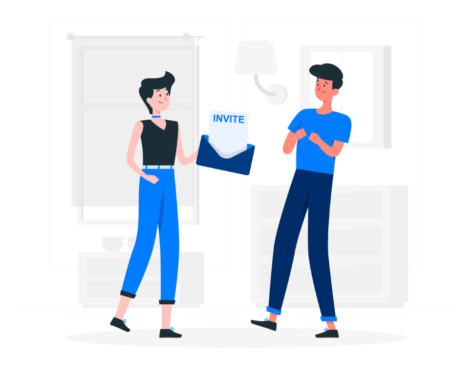

Fancy coming to the party?

Title separator

Functional langauge - inviting and responding to invitations

making and responding to invitations

LESSON OVERVIEW

The main objectives of this lesson are to:

  • share likes and dislikes about invitations and events;
  • practise phrases for making and responding to invitations;
  • listen to a recording where people make, accept and decline invitations.

With this lesson, students talk about preferences related to invitations and events. They work with phrases to make and reply to invitations (e.g. How about…?, That sounds great., I’m sorry, I can’t.), listen to a recording where people use those phrases and discuss invitation challenges and social dilemmas. Students also do a role-play where they take turns making invitations and accepting or declining them.

A2 / Pre‐Intermediate60 minStandard LessonUnlimited Plan

WARM-UP AND DISCUSSION

This lesson, where students practise making and responding to invitations, starts with a warm-up. Students talk about situations involving recent invitations. Afterwards, they brainstorm some verbs or phrases to use with the noun ‘invitation’. Then, students look at some events (e.g. dinner with friends, birthday party, conference) and discuss questions about event invitations. Following that, they read statements about personal preferences about invitations and events (e.g. I like throwing surprise birthday parties for my friends.) and say which ones are true for them. Next, students look at situations related to invitation challenges and social dilemmas. They say what they would do in each of them.

RECORDING AND ROLE-PLAY

In this part of the lesson, students arrange the lines of dialogues in the correct order. They then listen to a recording of people making and responding to invitations and check their answers. Following that, students put phrases from the previous task (e.g. Are you free?, Yes, I’d love to…, Thank you for the invitation, but…) in the correct categories (inviting, saying yes to an invitation and saying no to an invitation). Afterwards, they complete gaps in dialogues. Next, students complete each dialogue by writing the missing lines. After that, they work in pairs. Students look at a poster containing events in the city. Students do tasks where they invite their partner to the events and role-play conversations using phrases related to invitations.

HOMEWORK/REVISION

This lesson plan also includes an additional task that you can use as homework or revision. In the task, students unscramble phrases in dialogues. They then put the lines in each dialogue in the correct order. The task is available in the teacher’s version of the worksheet. You can print it and hand it out to your students. It’s also included in the e-lesson plan.

WORKSHEETS

Comments

Title separator

Leave a Reply

  1. Maggie Meyer

    This looks like an excellent lesson, I will try this with a small group of adult learners tomorrow. I think the language is useful. Thank you!

    1. Inna

      Thank you for your comment, Maggie! Hope you will also share how the lesson worked out with your students 🙂

Browse other materials recommended for you

Title separator
talking about brands
A2 / Pre‐Intermediate | B1 / Intermediate
Speaking Class 45 min / 60 min

The power of brands

Business Lifestyle

Get students talking about brands with this lesson! They share their views, learn the brand and the common name for products and watch a video on this topic. Students can also do an extra vocabulary task.

ESL speaking lesson about celebrities
A2 / Pre‐Intermediate | B1 / Intermediate
Speaking Class 45 min / 60 min

Life of a celebrity

General Lifestyle

Talk about the lives of famous people in this ESL lesson about celebrities! Students share opinions, explore how celebrities live and watch a video about a retired celebrity who now lives on a farm.

speaking lesson on art
A2 / Pre‐Intermediate | B1 / Intermediate
Speaking Class 45 min / 60 min

Art at home

Lifestyle

Get students talking about art with this lesson! They discuss items people have at home, watch a video about an art collector’s house and describe rooms with artworks. They can also do an extra task to review useful words.

practise high numbers
A1 / Elementary | A2 / Pre‐Intermediate
Standard Lesson 60 min

How many people live in your country?

General Lifestyle

Talk about countries, capitals and populations with this lesson! Students review vocabulary for nature and places and practise high numbers. They also read short texts and discuss their own countries.

lesson about going on holiday
A2 / Pre‐Intermediate
Speaking Class 45 min / 60 min

Going on holiday

Lifestyle

Discuss holidays and travel with this lesson! Students talk about holiday preferences, watch a video on Australia’s attractions and share their experiences. They also explore tourist problems and practise functional language for asking for help.

expressions of frequency
A1 / Elementary | A2 / Pre‐Intermediate
Standard Lesson 60 min

How much time do you spend…?

Lifestyle

Talk about how people spend their time! Students watch a video on teenagers’ phone habits, share their routines and practise expressions of frequency. They also discuss a graph about people’s routines in different countries.

speaking lesson on daily routine
A2 / Pre‐Intermediate
Speaking Class 45 min / 60 min

My typical weekday is…

Lifestyle

Step into the world of routines with this speaking lesson! Students talk about days of the week, daily tasks and unexpected changes. They watch a video and can also do an extra vocabulary activity. 

ESL lesson on enjoying life
A2 / Pre‐Intermediate | B1 / Intermediate
Speaking Class 45 min / 60 min

My perfect day

General Lifestyle

Engage students in discussing ways to enjoy life! They watch the trailer for the film Perfect Days, read about activities that promote presence and simple joys and discuss problems and solutions for different things in life. Students can also do an extra vocabulary activity.

beginner lesson on homes
A1 / Elementary | A2 / Pre‐Intermediate
Standard Lesson 60 min

This is my home

Lifestyle

Engage students in discussing homes with this beginner lesson! Students talk about their homes, watch a video about a small flat and practise pronunciation skills. They also share their perspectives and opinions.

Show more lessons

Questions

Title separator

Is there a minimum subscription period if I choose a monthly subscription?

No, there's no minimum required number of subscription months. You can cancel any time you want. Basically, you can sign up and then cancel your subscription the next day, which will mean you have access for 1 month and won't be charged again.

What currencies can I pay in for my subscription?

Our default currency is USD (American dollar), but you can also pay in EUR (euro), GBP (British pound sterling) or PLN (Polish zloty). You can change the currency you want to pay in at the Pricing page before selecting a subscription plan.

How can I edit an e-lesson plan?

You can get your own editable copy of an e-lesson plan and make changes to it. To do so, either (1) make a copy of it on your Google Drive (preferable method) or (2) download it in a Powerpoint format (but formatting might be a bit off so we can’t guarantee that it will work well).
Read more FAQ
Title separator

ESL Brains

Forgot password?
or continue with
Title separator
Title separator
Close icon
Looking for the perfect gift? Give the gift of ESL Brains access!
Gift of ESL Brains access