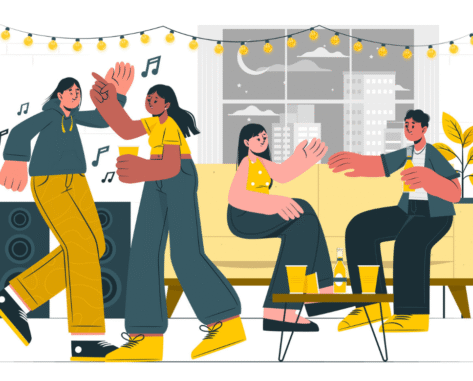
Let’s have a party! (going to)

Title separator

Grammar - be going to

ESL lesson on be going to

LESSON OVERVIEW

The main objectives of this ESL lesson on be going to are to:

  • discuss parties, share experiences and give opinions;
  • learn and use the structure be going to to talk about the future;
  • practise the phrases for party preparations.

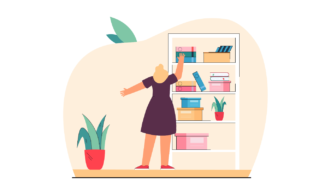
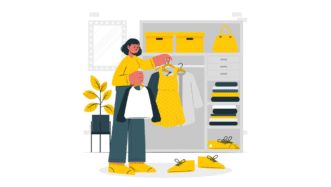
In this lesson, students discuss party preferences and explore phrases related to getting the house ready for guests (e.g. bake a cake, wash the dishes, clean the floor). They complete a dialogue, share their experiences and learn how to use the be going to structure. Students also talk about future scenarios, answer questions and work in pairs, imagining planning a party.

A1 / Elementary
A2 / Pre‐Intermediate
60 minStandard LessonPremium Plan

WARM-UP AND USEFUL PHRASES

This ESL lesson on be going to starts with a warm-up. Students look at photos (decorations, music and snacks) and say if they are important for them at a party. They give details. Afterwards, students examine statements about party preferences (e.g. I buy/make snacks for parties, because…). They choose the options that are true about them and complete the sentences with their own ideas. Following that, students match photos with pre-party tasks (e.g. this person needs to tidy the flat). They then review the activities from the previous task (e.g. tidy the flat, set the table, bake a cake) and do tasks where they talk about party preparation and preferences. Moving on, students complete a dialogue with missing words. Next, they guess what kind of party the people are talking about. Then, students discuss getting together with others.

BE GOING TO PRACTICE

In this part of the ESL lesson on be going to, students use sentences (e.g. I’m going to bake a cake) to complete the rules about the structure be going to and understand how to use it. Afterwards, they choose the correct form of be going to in statements about different topics (e.g. Pablo not going to/is going not to/is not going to visit his aunt). Following that, students complete gaps to form be going to sentences. Moving on, they use the correct form of be going to and verbs to complete gaps in question-based scenarios about future plans. Then, students create possible answers to the questions from the previous task. Finally, they imagine they are planning a party and write things they are going to do or not do. In pairs, students exchange lists, ask questions to find out their partner’s plans and report on them. They then swap roles.

HOMEWORK/REVISION

This ESL lesson on be going to also includes an additional task that you can use as homework or revision. In the task, students look at different situations and say one thing the people are going to do and one thing they aren’t to help them succeed. The task is available in the teacher’s version of the worksheet. You can print it and hand it out to your students. It’s also included in the e-lesson plan.

WORKSHEETS

Comments

Title separator

Leave a Reply

Browse other materials recommended for you

Title separator
talking about transport
A2 / Pre‐Intermediate | B1 / Intermediate
Speaking Class 45 min / 60 min

Transport today and tomorrow

General Lifestyle

Get students talking about transport with this lesson! They review transport vocabulary, watch two short videos about new transport options and discuss the advantages and disadvantages of transport choices.

ESL lesson on demonstrative pronouns
A1 / Elementary
Standard Lesson 60 min

This or that? (demonstrative pronouns)

Grammar

Students practise demonstrative pronouns with this lesson! They talk about things they see around them, review the terms ‘near’ and ‘far from’ and listen to recordings of dialogues.

ESL speaking lesson about celebrities
A2 / Pre‐Intermediate | B1 / Intermediate
Speaking Class 45 min / 60 min

Life of a celebrity

General Lifestyle

Talk about the lives of famous people in this ESL lesson about celebrities! Students share opinions, explore how celebrities live and watch a video about a retired celebrity who now lives on a farm.

family and appearance vocabulary
A1 / Elementary | A2 / Pre‐Intermediate
Standard Lesson 60 min

Who’s who?

General

Practise family and appearance vocabulary with this lesson! Students discuss family from various perspectives, review vocabulary for describing people’s appearance and work with the British royal family tree.

ESL lesson on minimal pairs
A2 / Pre‐Intermediate
Standard Lesson 60 min

She sells shells (minimal pairs)

General

Discuss tricky sounds with this ESL lesson on minimal pairs! Students read tongue twisters, watch an advert and practise listening skills. They also work in pairs, creating sentences and guessing minimal pairs.

ESL lesson on can and can’t
A1 / Elementary
Standard Lesson 60 min

Show your talent! (can, can’t)

General Grammar

In this lesson, students talk about talents and abilities! They practise can and can’t, review vocabulary for activities and discuss what people can do. Students also listen to a recording and watch a video of a talent show.

useful role-play situations
A2 / Pre‐Intermediate | B1 / Intermediate
Standard Lesson 60 min

New place, new start

General

Practise useful language for moving to a new place! In this worksheet, students talk about housing, money, getting around and neighbours. They listen to short conversations and explore real-life dialogues through role-plays.

talking about physical activities
A1 / Elementary | A2 / Pre‐Intermediate
Standard Lesson 60 min

How active are you?

General

Get students talking about physical activities! They read comments, practise collocations for activities and discuss past experiences. They also write short texts and work in pairs!

phrases for likes and dislikes
A2 / Pre‐Intermediate | B1 / Intermediate
Standard Lesson 60 min

Pineapple pizza isn’t my thing

General

Talk about favourite dishes with this lesson! Students share experiences, watch part of a video on American presidents’ favourite foods and practise phrases for asking about preferences and expressing likes and dislikes.

Show more lessons

Questions

Title separator

Is there a minimum subscription period if I choose a monthly subscription?

No, there's no minimum required number of subscription months. You can cancel any time you want. Basically, you can sign up and then cancel your subscription the next day, which will mean you have access for 1 month and won't be charged again.

What currencies can I pay in for my subscription?

Our default currency is USD (American dollar), but you can also pay in EUR (euro), GBP (British pound sterling) or PLN (Polish zloty). You can change the currency you want to pay in at the Pricing page before selecting a subscription plan.

How can I edit an e-lesson plan?

You can get your own editable copy of an e-lesson plan and make changes to it. To do so, either (1) make a copy of it on your Google Drive (preferable method) or (2) download it in a Powerpoint format (but formatting might be a bit off so we can’t guarantee that it will work well).
Read more FAQ
Title separator

ESL Brains

Forgot password?
or continue with
Title separator
Title separator