Do you enjoy quiz shows? (question tags)

Title separator

Grammar - question tags

question tags lesson

This is a standalone lesson but it can also be used as part of the set titled:

LESSON OVERVIEW

The main objectives of this lesson are to:

  • learn to form question tags, 
  • apply general knowledge to practise forming question tags,
  • practise expressing uncertainty about facts using question tags.

With this question tags lesson plan, students learn to use question tags when they are uncertain about some facts. They do a general knowledge quiz. They also talk about quiz shows and watch people answering general knowledge questions.

B1 / Intermediate
B2 / Upper Intermediate
60 minStandard LessonPremium Plan

VIDEO & QUESTION TAGS

This question tags lesson starts with a warm-up activity. Students discuss what general knowledge is and assess the state of their knowledge. Then, they watch the video and decide whether the questions in it are general knowledge questions. You can also choose to pause the video before the quiz show participants provide their answers. After that, students match halves to sentences with question tags (e.g. The driest place in the world is in the Atacama Desert, isn’t it?). They also need to tick rules that apply to using and forming question tags. Then, students match the sentences with answers. Next, students complete gaps with question tags. They also need to answer the questions. 

QUIZ SHOWS

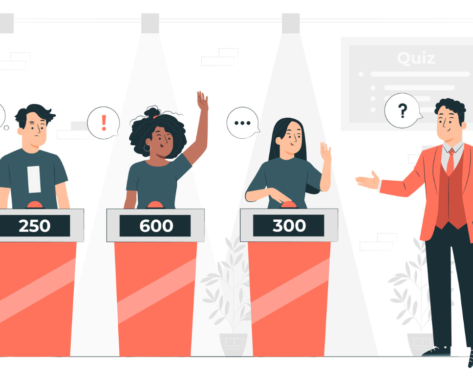
The second part of this question tags lesson starts with a discussion. Students talk about quiz shows, explain rules of some, think of winning strategies, etc. Then, they answer questions from a quiz using question tags to confirm with their partner (e.g. There are four time zones in Brazil, aren’t there?). Finally, students play a game based on the quiz show Who Wants to Be a Millionaire?. If they are unsure about a rule, they can use a question tag to check with you. There are four sets of questions in the teacher’s pdf and the e-lesson plan. 

HOMEWORK/REVISION

This question tags lesson also includes an additional task that you can use as homework or revision. In the task, students practise creating question tags. The task is available in the teacher’s version of the worksheet. You can print it and hand it out to your students. It’s also included in the e-lesson plan.

WORKSHEETS

Comments

Title separator

Leave a Reply

  1. Anastasia

    Hi! Thank you for such a wonderful lesson, but I failed to find the 4 sets of questions without answers to play the game.

    1. Ewa

      Thanks! The questions are on slides 28-31 (the slides are hidden so that students don’t see the answers) and on pages 5-6 of the teacher’s pdf.

      1. Anastasia

        But the right answers are highlighted there, so there aren’t tests without highlighted answers neither in the teacher’s pdf or on slides

        1. Ewa

          The game that you are referring to (ex. 8/slide 27) is based on the game show ‘Who wants to be a millionaire?’. The objective of the game isn’t to take a test but to communicate with team members and the teacher using question tags. This is why the teacher needs to read the questions out to students instead of showing the questions to them. See more details in ex. 8/slide 27.

  2. Maria K

    Hi! The lesson is a good introduction to question tags, but besides covering the form and structure, it should also mention the intonation pattern, as it’s quite significant!

    1. Ewa

      Thanks for the comment 🙂 I think I decided not to include info about intonation because the lesson is already packed and the context doesn’t really provide that much opportunity for students to practise both rising and falling intonation. I’d say this is something that more advanced students could practise. For those who’ve just learnt qustion tags, any intonation they use will probably do.
      Having said that, stronger students might benefit from some controlled pronunciation practice here. I’d probably use exercise 6 (slide 8) for that. I’d first read sentence A with the question tag out loud with rising, then falling intonation, ask students which one made me sound unsure of the answer and then drill the sentences in this task using first rising, then falling intonation.

      1. Maria K

        Thank you, Ewa! I really appreciate your response and your thoughtful teaching suggestion.

Browse other materials recommended for you

Title separator
will and would for present and past habits
B2 / Upper Intermediate | C1 / Advanced
Standard Lesson 60 min

They just won’t stop playing!

Grammar Lifestyle

Talk about toys from a critical perspective in this lesson! Students review will and would for present and past habits, practise phrases for consumer behaviour and watch a video about the popular toy Labubu.

ESL speaking lesson about celebrities
A2 / Pre‐Intermediate | B1 / Intermediate
Speaking Class 45 min / 60 min

Life of a celebrity

General Lifestyle

Talk about the lives of famous people in this ESL lesson about celebrities! Students share opinions, explore how celebrities live and watch a video about a retired celebrity who now lives on a farm.

ESL lesson on eating out
B1 / Intermediate
Vocabulary Lab 45 min / 60 min

Let’s eat out!

General

Work on dining situations with this ESL lesson on eating out! Students talk about going out to eat, review useful vocabulary and share experiences. They also listen to restaurant dialogues and role-play dining scenarios.

using so and neither
B1 / Intermediate
Standard Lesson 60 min

Do you buy second-hand? So do I!

Grammar Lifestyle

Explore second-hand fashion with this lesson! Students watch a video about the second-hand clothing business, discuss their experiences and practise structures for agreeing with so, neither and auxiliary verbs.

useful role-play situations
A2 / Pre‐Intermediate | B1 / Intermediate
Standard Lesson 60 min

New place, new start

General

Practise useful language for moving to a new place! In this worksheet, students talk about housing, money, getting around and neighbours. They listen to short conversations and explore real-life dialogues through role-plays.

phrases for complaints
B1 / Intermediate
Standard Lesson 60 min

Sorry to bother you, but… (making complaints)

Business General

Practise useful phrases for complaints! Students watch a video about complaining in restaurants and explore polite ways to make and respond to complaints. They also role-play complaint situations.

phrases for likes and dislikes
A2 / Pre‐Intermediate | B1 / Intermediate
Standard Lesson 60 min

Pineapple pizza isn’t my thing

General

Talk about favourite dishes with this lesson! Students share experiences, watch part of a video on American presidents’ favourite foods and practise phrases for asking about preferences and expressing likes and dislikes.

food vocabulary
A2 / Pre‐Intermediate | B1 / Intermediate
Vocabulary Lab 45 min / 60 min

What’s for lunch?

General

Practise food vocabulary with this worksheet! Students talk about dishes and ingredients and discuss fruits, vegetables, meats and seafood. They also work in pairs and play a word game.

ESL lesson on human organs
B2 / Upper Intermediate
Vocabulary Lab 45 min / 60 min

Inside the human body

General

In this ESL lesson on human organs, students practise vocabulary for body parts and systems. They explore their functions, talk about health and listen to an audio on how city life can affect wellbeing.

Show more lessons

Questions

Title separator

Is there a minimum subscription period if I choose a monthly subscription?

No, there's no minimum required number of subscription months. You can cancel any time you want. Basically, you can sign up and then cancel your subscription the next day, which will mean you have access for 1 month and won't be charged again.

What currencies can I pay in for my subscription?

Our default currency is USD (American dollar), but you can also pay in EUR (euro), GBP (British pound sterling) or PLN (Polish zloty). You can change the currency you want to pay in at the Pricing page before selecting a subscription plan.

How can I edit an e-lesson plan?

You can get your own editable copy of an e-lesson plan and make changes to it. To do so, either (1) make a copy of it on your Google Drive (preferable method) or (2) download it in a Powerpoint format (but formatting might be a bit off so we can’t guarantee that it will work well).
Read more FAQ
Title separator

ESL Brains

Forgot password?
or continue with
Title separator
Title separator