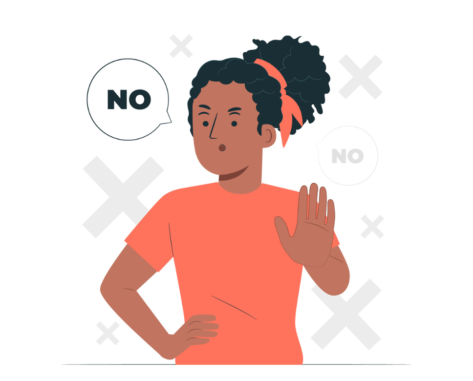
Learning to say ‘no’

Title separator

LESSON SET OVERVIEW

With this lesson set, your students will:

  • learn useful expressions for saying that they’re busy,
  • discuss why it’s difficult for people to say ‘no’,
  • watch a video with strategies on how to say ‘no’,
  • learn phrases to say ‘no’ politely,
  • practise the phrases through role-play,
  • discuss the topic of personal boundaries and watch a video explaining the concept,
  • learn collocations with the word ‘boundaries’,
  • discuss people’s possible responses to difficult situations.

This lesson set focuses on ways to say ‘no’ and the importance of protecting personal boundaries.

This is a lesson set. Use the lessons in the set in the suggested order. Learn more about sets here.

Each lesson in the set is also a standalone lesson.

Lesson 1 Teach students how to say ‘no’
saying no in English
Standard Lesson 60 min Premium Plan

I wish I could but I don’t want to

General

Students learn useful phrases on how to say they’re busy (e.g. I have a lot on my plate) and functional vocabulary on how to say ‘no’ politely. They also watch a video with strategies and do role-play.

Lesson 2 Let students practise saying ‘no’ while discussing personal boundaries
talking about personal boundaries
Standard Lesson 60 min Premium Plan

From a pushover to your own boss

General

Students discuss the concept of personal boundaries and practise collocations with the word ‘boundaries’. They also identify different types of personal boundaries and reflect upon responses to challenging situations. Encourage students to use phrases to say ‘no’ when discussing responses in ex. 9 and 10 (slides 47, 49).

Comments

Title separator

Leave a Reply

Browse other sets for this level

Title separator
B1 / Intermediate | B2 / Upper Intermediate
2 lessons

You’ve lived abroad, haven’t you?

General Grammar

Teach students question tags! In the first lesson, they practise using question tags in the context of geography and history, and in the second lesson, the context is the experience of culture shock.

B2 / Upper Intermediate | C1 / Advanced
2 lessons

Shop till you drop?

Global Issues Grammar Lifestyle

Help students practise talking about habits using ‘will’ and ‘would’! Students talk about collectable toys, as well as fashion or shopping habits, depending on the lesson you choose.

B2 / Upper Intermediate | C1 / Advanced
2 lessons

Being handy around the house

General

Talk to students about fixing broken objects and about DIY projects. Teach them names of tools and useful verbs to talk about what needs to be fixed and changed around the house.

B1 / Intermediate | B2 / Upper Intermediate
2 lessons

Online life

Lifestyle Technology

Engage students in a conversation about social media! Students talk about online habits and explore vocabulary. They also discuss how to manage children’s online behaviour and talk about location sharing and tracking.

B1 / Intermediate | B2 / Upper Intermediate
2 lessons

What life used to be like

General Grammar Lifestyle

Encourage students to talk about the past with this set! They practise using ‘used to’ and ‘would’ while talking about their life when they were children as well as people’s lives in the ‘90s.

B1 / Intermediate | B2 / Upper Intermediate
3 lessons

A crime has been commited

General Grammar Technology

Help students learn to use passive voice in different tenses! Students also talk about different crimes and report some news.

B1 / Intermediate | B2 / Upper Intermediate
2 lessons

They should be allowed to do it! (modal verbs)

General Global Issues Grammar

Students practise modal verbs of permission, obligation and advice, as well as verbs to talk about prohibition. They discuss legal age limits and a ban on cigarettes.

B1 / Intermediate | B2 / Upper Intermediate
2 lessons

Dealing with teenagers

General

This lesson set allows students to discuss teenage life and digital parenting in depth. Students learn topic-related vocabulary and learn expressing cause and effect.

B2 / Upper Intermediate
3 lessons

Money, money, money

Business General

Students learn and practise money-related vocabulary. They learn the vocabulary in lessons 1 and 2, and practise it while discussing shopping.

Show more lessons

Questions

Title separator

Is there a minimum subscription period if I choose a monthly subscription?

No, there's no minimum required number of subscription months. You can cancel any time you want. Basically, you can sign up and then cancel your subscription the next day, which will mean you have access for 1 month and won't be charged again.

What currencies can I pay in for my subscription?

Our default currency is USD (American dollar), but you can also pay in EUR (euro), GBP (British pound sterling) or PLN (Polish zloty). You can change the currency you want to pay in at the Pricing page before selecting a subscription plan.

How can I edit an e-lesson plan?

You can get your own editable copy of an e-lesson plan and make changes to it. To do so, either (1) make a copy of it on your Google Drive (preferable method) or (2) download it in a Powerpoint format (but formatting might be a bit off so we can’t guarantee that it will work well).
Read more FAQ
Title separator

ESL Brains

Forgot password?
or continue with
Title separator
Title separator
Close icon
Looking for the perfect gift? Give the gift of ESL Brains access!
Gift of ESL Brains access